Hydrogen measurement
A hydrogen measurement shows parts per million (ppm) or parts per trillion (ppb) of molecular hydrogen (H2 ), which is dissolved as a gas in water. This measurement used to be a job for a few specialists with special laboratory equipment.

Above: Polarographic DH measuring device (“dissolved” hydrogen) from TOA-DKK, which is also certified for research into electrolyzed water.
Following the start of the “hydrogen-rich water” boom in the year 2010 This created a need for less complicated and cheaper methods of hydrogen measurement.
In the year 2012 MIZ – Company (Japan), a developer of new electrolysis technologies for hydrogen-rich water, presented its MIZ reagent. “A convenient method for determining the concentration of hydrogen in water: with the use of methylene blue with colloidal platinum” (Seo et al. Medical Gas Research). 2012, 2:1The liquid, offered in drop form and based on methylene blue and platinum, is said to decolorize to colorless leucomethylene in the presence of dissolved hydrogen. It can then be used to precisely determine the hydrogen content. 1 decolorized drops in a 6 ml cup with water means 100 ppb (0,1 ppm) dissolved hydrogen in water.
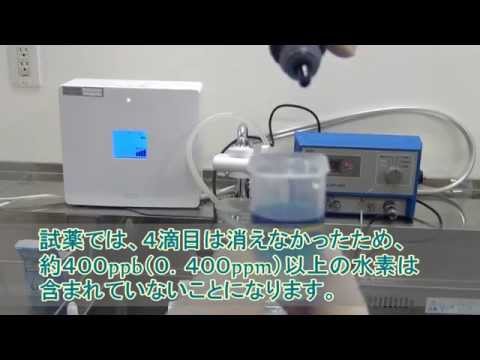
A control test conducted by the renowned water ionizer manufacturer Nihon Trim demonstrated this. Alkaline activated water pH 9 was tested with a polarographic laboratory device and had 604 ppb dissolved hydrogen. However, the drops only yielded 300 ppb.
Nihon Trim wrote in the video description: “These reagent drops are tailor-made for the hydrogen water devices manufactured by MIZ.”
The Nihon Trim control attempt was 2014 published. An organization from the USA is also now distributing a dropper set based on the same concept under the name "H2 blue™ test kit.
I followed several stages of development of these drops and compared them with electronic hydrogen measurement and titration with iodine. Depending on the type of hydrogen production, the results sometimes differed significantly from those of an electronic measurement or calculation using the redox potential. What was noticeable was that the methylene blue turned to azure blue when the hydrogen-rich water was obtained with a diaphragm water ionizer. However, this does not happen with a PEM/SPE hydrogen generator, which does not make the water more alkaline.
At the beginning 2016 However, no azure blue was produced in the tested samples when a weak alkali with the same pH value was used (9,5) such as alkaline activated water. This was also not the case with the production of catholyte.
Meanwhile, after lengthy discussions with the manufacturer and the Molecular Hydrogen Foundation, the drops have been better buffered against degradation by hydroxide ions and have been functioning since mid-2000. 2016 It works perfectly even with alkaline activated water. Control measurements showed that even the Japanese MIZ reagent drops, which Nihon Trim criticized, now deliver correct values. In my opinion, both brands can now be used, although the American brand is significantly cheaper.
Incidentally, it is by no means clear from the scientific literature what level of dissolved hydrogen constitutes a “therapeutic level”.
Tyler Le Baron, the leading figure in the US hydrogen water movement, wrote to me about this: “There really aren’t enough studies on this question yet. It depends on the individual and the illness, and on how much one drinks, for example.” 1 liters with 1000 ppb or 5 liters with 500 ppbIn some cases, 80 ppb Some need enough, while others need more. The standards developed by Shigeo Ohta in Japan assume a minimum of 800 ppb They should be. I personally think they should be at least 500 ppb "But that also requires drinking a larger amount of water."
Excerpt from the book by Karl Heinz Asenbaum: “Electro-activated water – An invention with extraordinary potential. Water ionizers from A – Z”, www.euromultimedia.de