
Descaling on-table & under-table water ionizer | Alkaline hydrogen water is rich in alkaline minerals (Ca, Mg, Na, Ka, ..) - so limescale is an issue, just like in the kettle!

Is calcium in water good or bad for the organism?
Every water ionizer must be descaled regularly. How often depends on the following factors:
- Water hardness, i.e. the lime content of your tap water: – the harder your water, the faster the device can calcify
- Water flow: – the slower the faster the device becomes calcified
- Which ionization level is used: – At the highest level, the device calcifies faster than at the weaker ionization levels.
- The limescale protection mechanism is used. Very few water ionizers are well protected against limescale buildup on the electrode plates. The following brands are among those that are well protected against limescale. AquaVolta® Moses 7All EOS and Alkamedi (or in Germany Aquion) water ionizers
More information is available in the following FAQ posts with videos. Information about filter changes can be found on this website
Find all water ionizer instructions here: www.aquacentrum.de/water-ionizer-manual/
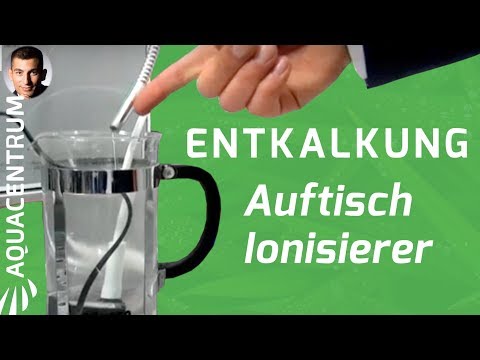
Descaling | Water ionizer maintenance
RESPO
Descaling | Water ionizer maintenance
My water ionizer delivers the desired pH and redox values, but hardly any dissolved molecular hydrogen
Hello Mr. Asenbaum,
Unfortunately I have with the freshly bought ones H2 Blue Kit drops cannot determine hydrogen content.
Why is that?
The Titanion SE Ultra was freshly descaled and was tested at pH 9 bottled 1,4 Liter.
The redox value was over -500mV or even -600mV; I have many measuring devices, as I use the alkaline water for testing purposes in my company, and all of them 3 They displayed the same thing. The pH value was closer to... 9,5 in all measurements.
I look forward to your feedback
All the best
Roland D.
 Titanion SE water ionizer
Answer from Karl Heinz Asenbaum | Freshly decalcified, the water ionizer delivers high hydrogen concentrations
Hello Mr. D.,
Yes, these results are correct. At least I can say that for the pot-type appliances. The Titanion SE Ultra should deliver much more, unless it's scaled up. Unfortunately, I don't have one anymore and can't tell you exactly what it does, but with proper use, it should certainly deliver at least... 1,2 ppm dH2.
To explain, I assume you can speak English, here is Tyler Le Baron's very good explanation of this phenomenon of a divergence between redox value and hydrogen value, which he sent to me by email. Please do not publish.
I wrote to him first. :I used an Aquator batch ionizer from Lithunia because a potential client wanted to know how much dH2 can be produced with this device that goes back to the Soviet Research Team of Prof. Alyokhin and is optimized to produce extremely low ORP. In the production process temperature was elevated from 16 to 22 C degrees. (The device works with 110 V DC. Prefiltered Tap water Munich was used)
* The result was indeed a very low ORP – 761 mV (CSE) at a pH of 9.8.
* dH2 with H2 blue was 0,2 ppm
He replied: It only takes maybe 0.05 ppm to get a very negative ORP…Especially if the water is alkaline. In fact, with water ionizers I have seen that you can have a 0.05 ppm, pH 10 and ORP is -780 mV, but then after cleaning the machine (which helps the H2 to dissolve better), the pH still went to 10, the ORP -780 mV, but the dH2 at 1.2 ppm.
In normal water you only have around 0.0000001 ppm, so if you increase the H2 concentration by 1 MILLION times, then you will get 0.1 ppm and your ORP will go from +200 mV to -500 mV (for example), now, if you increase the H2 concentration ONLY ten times to 1.0 ppm, you are going to have nearly the same ORP. A change of only ten, is a lot smaller than a million. Plus the ORP value is also logarithmic, so very small changes in actual concentrations and ratios result in very large changes in the value.
So this is why a negative ORP cannot be used to estimate the concentration of hydrogen. If you have a high negative ORP you have no idea what concentration of H2 there is, it could be low or high. However, you will NEVER have a high concentration of H2, with a small or positive ORP reading (as long as it is pure water and not dH2 water with other oxidizing chemicals that can make the value positive).
I hope this helps to clarify things for you. Newer ionizers with improved electrode surfaces, like ours, Aquavolta Moses or Aquavolta ECA tractors produce significantly more hydrogen than the old flat or mesh electrodes. This can amount to up to... 2,9 ppm Possible. Provided, of course, that the device is not scaled up.
With kind regards,
Karl Heinz Asenbaum
www.quantomed.com
Communication with Yasin Akgün about descaling water ionizers
Hello Mr Akgün,
The Titanion operating instructions state that you should leave strongly acidic water in the device to descale the device.
Alternatively, if there is a lot of limescale, you can fill the device with vinegar water.
Since the PH value and redox were always OK, I previously thought that this was enough.
Mr. Asenbaum has now advised me that Descaling with citric acid, in circulation with a separate pump.
I'll try it that way, but I still have to get a suitable pump.
With kind regards,
Roland D.
Need for descaling a water ionizer
Edna R.: My water ionizer has a fully automatic descaling system. Why do I have to descale it manually now?
- You have to change a baby, you have to walk a dog, you have to descale a coffee machine and a water ionizer. That's part of the system. Unfortunately, manufacturers use the term “automatic self-decalcification” very liberally. That's why I'll give you some background information: Limescale deposits in water ionizers always form on the negative pole, i.e. the cathode, which releases negatively charged electrons into the water. Positively charged calcium ions are attracted to it and then stick to the metal in increasingly thick layers. This reduces the surface area of the cathodes, so that the overall performance of the —> Electrolysis cell decreases.
- In addition, the cathode side of a diaphragm can become calcified. These deposits must be removed using decalcification systems. There are various systems on the market for this.

- Method 1: Preliminary descaling: At the beginning of the dispensing process, the current is diverted for approximately... 30 The polarity is reversed for a few seconds. This turns the cathode into the anode, which repels calcium due to its positive charge. During the polarity reversal, the device issues warnings that the water from the alkaline water outlet is no longer potable. This only works perfectly in the long run if the water is dispensed only after the current is switched back. 30 It takes seconds. However, water is usually drawn for longer, so the cathode eventually builds up a layer of limescale. Disadvantage: The user has to 30 Wait a few seconds until you get alkaline activated water. Advantage: Warmed, stagnant water from the tap and pre-filter flows out. However, the average consumer would wait until the water comes out of the tap cold anyway.
- Method 2: Subsequent descaling: After the end of the dispensing process, the device holds water in the electrolysis cell for a few seconds and reverses the polarity of the current as in the previous method. 1The flow is then released via a drainage pipe to the acidic water outlet. Advantage: No waiting time. Disadvantage: Only a few seconds of reverse flow, and at the start of dispensing, lukewarm stagnant water from the pre-filter and pipe. Time passes before the water cools down, during which time a limescale layer can build up. Conclusion: Inferior to the other method. 1But very effective if the method is used. 1 and 2 combined, meaning the current is reversed before and after tapping.
- Method 3: Cyclic descaling: The current is interrupted after a certain flow rate or a certain time (usually every [time period]). 12 hours) for a 30-Second cleaning cycle with alarm signals reversed. Advantage: Technically simpler than other methods. 2 and therefore cheaper. Disadvantage: Especially when dispensing small amounts several times a day, 12 Hours without descaling, even though a large quantity was produced. Therefore, high susceptibility to limescale and frequent manual descaling are necessary. Annoying: Even if 12 If no activated water has been produced for several hours, a descaling cycle with current reversal is performed.
- Method 4: Flow Change – pole change and flow reversal: After each tap stop, the cell chamber previously used as a cathode chamber becomes the anode chamber by changing the current polarity and directing the flow to the other outlet.
This results in permanent self-decalcification. - Advantages: With smooth electrode construction (—> Electrolysis cell), this method reliably protects against calcification of the cell.
This method was patented by the Korean company Alkamedi (European brand name Aquion®). - Disadvantages: As a rule, only alkaline activated water and never acidic water flows through the upper spout. Since alkaline active water begins to relax immediately after production (—> Relaxation time), minerals are constantly deposited from the moment it leaves the cell until the outflow, which can gradually narrow the outflow.
Therefore, manual descaling is also necessary if the flow rate decreases. Just not that often.

- Method 5: Manual descaling. If the output pH value achieved has noticeably reduced with the same water flow rate or if the flow rate of the alkaline activated water has decreased compared to the sour water -
A maximum of the same amount of acidic activated water should flow out, never more than alkaline water). You have to descale manually.
Most manufacturers specify fixed intervals for certain water hardness.
Premium devices even provide automatic notifications that manual descaling is due.
Please pay attention to these instructions and do not forget to disconnect the device from the power supply.

- Please carry out manual descaling using the descaling pump supplied or available as an accessory according to the instructions.
The pump should run for at least one hour (until 12 run for hours) with the descaling agent.
This must not be warmer than 35 Grade C. - If there is severe calcification - for example, if citrates (lime salts of the descaling agent citric acid) precipitate as white crystals or the descaling agent turns yellow, you should replace the descaling solution.
Please do not forget to rinse the pump thoroughly with clear water after the descaling process, otherwise it will be blocked by incrustations next time.

- A clogged pump that won't start will usually work again after soaking it in clean water for an hour. After manual descaling, set your water ionizer to the "Purified" (filtered water) setting and let it run for about... 10 Run a liter of water through the system for rinsing. This is not drinking water and may still contain traces of the descaling agent.
Excerpt from the book by Karl Heinz Asenbaum "Electro-activated water – An invention with extraordinary potential. Water ionizers from A – Z”
Copyright 2016 www.euromultimedia.de
Hello Mr Akgün,
I have a question – next month I have to take my AquaVolta Descaling my Eos Genesis. Does the ionizer need to be switched on during descaling, or should the plug be disconnected so that only the pump is powered?
Otherwise I'm super happy with the device.
Kind regards, Klaus E.
Yasin Akgün's reply on 19.May 2016:
Hello Mr. E.,
Thank you for your question, which I am happy to answer. Theoretically, you can leave the power plug on and leave the device in standby mode. For safety reasons we have to advise against this in the instructions. But in practice it is even necessary because at the beginning of the descaling you first run water through the ionizer in order to remove the air bubbles from the pipes/outlets, as these tend to interfere with descaling and the pump can then have difficulties. to circulate the citric acid solution through the system.
It can also happen during descaling that the circuit is interrupted and you have to turn on the water ionizer for a short time to get water through. When descaling, carbon dioxide bubbles are created, which can also disrupt the pump.
Please note: Always operate the ionizer in filtered mode during the descaling process. You don't have to turn on the electrolysis with the citric acid.
Further information and videos can be found on this page: https://www.aquacentrum.de/ionisiererwartung/
Hope this helps you
Kind regards from Munich, Yasin Akgün
How often do I have to disinfect my water ionier?
Disinfection is usually not necessary. Descaling with a warm citric acid solution also represents disinfection in itself.
In some applications, e.g. in commercial settings or medical practices, it is definitely advisable to disinfect the outlet by spraying and wiping with 10%Disinfect with a hydrogen peroxide solution. This will eliminate any germs that could be transferred by touching the spout with bare hands. For particularly effective cleaning/disinfection, a complete flush of the device is recommended. 3,5%-iger hydrogen peroxide solution. You can obtain this at the pharmacy.
You can read how it's done in > this Disinfection instructions.
Descaling the Alkabest (ECAIA) water ionizer — step by step
The Alkabest water ionizer (formerly known as ECAIA from Sanuslife, manufacturer: Biontech/Korea) is a Special case in descalingUnlike most other water ionizers, it cannot simply be descaled via the wastewater or outlet hose.
Why is the descaling process different for Alkabest products?
With most water ionizers, you simply introduce the citric acid solution through the normal water inlet. With the Alkabest/ECAIA (and other Biontech models), this is different. not possible, because the internal waterway is constructed differently.
Instead, you must:
- The 2Remove filter
- A extra thick rubber hose connect to the filter opening
- Introduce the citric acid solution through this tube.
- Over the outlet the closing the loop (Bucket → Pump → Device → Bucket)
what you need
- submersible pump (A small aquarium pump is sufficient)
- citric acid 2-3 tablespoons on 1 liters of warm water
- Thick rubber hose — suitable for the filter opening
- pail — for the circulatory system
- Optional: pH test strips for control
Instructions: Descaling with a submersible pump
- Disconnect the device from the power supply and shut off the water supply
- Filter 2 For — carefully unscrew the rear/inner filter
- rubber tube insert into the now free filter opening
- Citric acid solution Mix in a bucket (lukewarm, not hot)
- submersible pump Place in the bucket and connect the hose.
- outlet hose also place in the bucket (circulation)
- Turn on the pump — the solution now circulates through the electrolysis cell
- 20-30 minutes circulate
- Turn off the pumpRemove the hose, reinsert the filter.
- Rinse the device thoroughly. 3-Run 5 liters of fresh water through
Tip: It is best to follow the official descaling video — the visual process is easier to understand than a purely textual description.
How often should you descale?
The descaling frequency depends on your water hardness away:
| water hardness | Descaling interval |
|---|---|
| Soft (0-8 °dH) | All 6-12 months |
| Medium (8-14 °dH) | All 3-6 months |
| Hard (over 14 °dH) | All 1-3 months |
Further descaling instructions for other devices:
Descaling instructions for the two Kangen Water ionizer | Kangen Enagic SD 501 & Kangen Enagic K 8
This video will show the Kangen The recommended descaling methods were explained. In our view, they are too ineffective and also time-consuming. Especially when... Kangen K8The citric acid used for descaling, also called cleaning powder, is a sticky substance. Pump impellers can become clogged with limescale and cause even more problems.
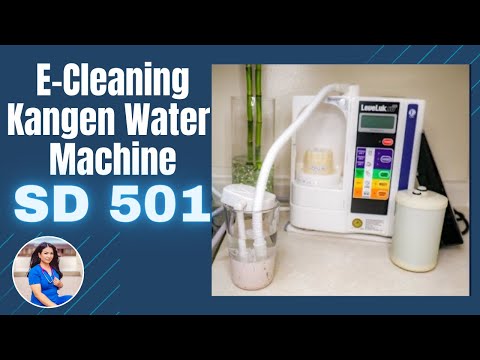
Extensive descaling Kangen Enagic SD501 with citric acid and descaling filter
It is best to descale your Kangen Water ionizer in a very old-fashioned way with a descaling pump and citric acidIt is called in the Kangen Language: Deep Cleaning, and is only performed via a service fee if you bring your device to Kangen Submit. You can find more videos about limescale on this page: www.aquacentrum.de/ionizer expectation/

Descaling a water ionizer with a flow dial
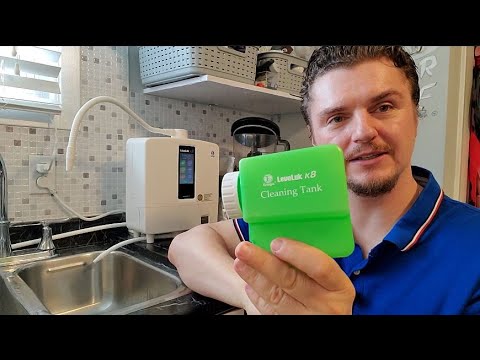
Kangen K8 Cleaning – step by step | Descaling K8 in English
After the last descaling at the beginning of October Lydia with the reducing screw fully open, only 1,7-1,8 l/min..
Previously, there were over 2 liters and I always had to reduce it a little with the screw.
I'm surprised and would perhaps have the descaling run through again. I don't have any other idea because the water pressure at the taps hasn't noticeably decreased...
If you see another option, please let me know as soon as possible...
Hello Mr. Tretow,
Thanks for your question.
If you've only recently descaled, I don't think that's the problem. You can't actually tell from the flow whether the device is calcified. But rather the ratio of the alkaline hydrogen water from the outlet compared to the acidic water (wastewater) from the wastewater hose. If the wastewater volume flow has increased and the volume flow at the top of the ionizer outlet has decreased, then the time has come.
The EOS devices produce approximately… 33 % Wastewater and 66% basic hydrogen water. If this ratio is approximately... 50% zu 50% If so, you can descale the appliance. Instructions on how to do this are provided here: www.aquacentrum.de/ionizer expectation/.
I think the flow rate has changed due to the T-fitting. That can happen. However, you don't need to increase it in your case, as with the EOS devices... 1,6 Liters per minute (alkaline water from the top outlet) is already a high flow rate. Your water is probably very soft. Have you measured the values? These can decrease slightly over time, especially if the appliance is no longer brand new.
I look forward to further questions
All the best from Munich, Yasin Akgün
Andrea G.: I sent my alkaline activated water to a laboratory to check for any remaining contaminants. The results were good, but I'm surprised that the water hardness is around 5 The German water hardness level was lower than that of our tap water! Does the filter actually remove the hard salts calcium and magnesium – or does that happen during electrolysis?
- No. Alkaline activated water is initially always significantly harder than the tap water from which it was obtained. However, your laboratory did not make any mistakes, because it certainly did not test alkaline activated water at all, because it... —> Relaxation time had already expired at the time of the analysis and the hardness-forming minerals were no longer in the water. In addition, the gas composition in the water and the lime-carbon dioxide balance have changed. You can easily test the greater hardness and therefore the higher mineral content yourself immediately after production if you hold a hardness test strip (available in aquarium stores) in the water.
- When the hard salts have precipitated after a few days, the relaxed activated water is actually softer than the tap water before. Why this is so would go too far here. However, you can track the drop in hardness with two hardness test strips. (aquarium supplies). Tea drinkers who prefer soft water can use the relaxed active water to make streak-free black tea.
- Ideally, you should drink fresh, untreated tap water cold. At this stage, it still contains a higher mineral content. Calcium and magnesium, which contribute to water hardness, are essential minerals for human life. These natural calcium and magnesium compounds also play a significant role in the water's good taste. Coffee connoisseurs consider calcium-rich water to be a better carrier of flavor. However, hard water can be problematic for technical applications such as washing. Generally, only softening the hot water is advisable, not the drinking water. In Austria, for example, such hot water softening is regulated according to ÖNORM M. 6245 only about 18°dH carbonate hardness is recommended. However, even after chemical softening (Codex Chapter B1 Drinking Water), a minimum hardness of 8,4exhibit ° dH (corresponds to 60 mg/l Calcium).
- If you also want to soften your cold tap water, the taste of your alkaline activated water may no longer be to your liking. Conventional water softeners use ion exchange to remove calcium from the water in favor of sodium. The result, especially at higher pH levels, is a slight baking soda taste. Incidentally, sodium is an element we often already consume in more than sufficient quantities through modern diets, while calcium, a major mineral, is present in our diets in the range of... 1 2 kg Having it in the body is practically always needed.
Excerpt from the book by Karl Heinz Asenbaum: “Electro-activated water – An invention with extraordinary potential. Water ionizers from A – Z”
Copyright 2016 www.euromultimedia.de
Softening by ion exchange – it is better not or the hardness should be set to low (°dH8 to °dH10).
By softening can the pH value of the water be reduced to one to 2 pH values are loweredAnd the water is also “artificial” with sodium (Na2+), replaced by calcium (Ca2+).
Lecture section | Ion exchanger or softening
Ion exchangers that are regenerated with salt (NaCl) are able to exchange calcium (Ca2+) and magnesium ions (Mg2+) for sodium ions (Na2+). This principle is e.g. B. used in dishwashers to protect the heating elements and avoid “limescale stains” on the dishes.
Water softeners for non-professional use to soften drinking water employ this principle. It is also occasionally used to treat small quantities of water, for example, for watering plants or making tea. Every Brita water filter, as well as ours, uses this principle. Aquaphor Water filters soften the water. We have [this information] at the Aquaphor® jug filters the lowest possible softening cartridge Aquaphor® B100-7 filter cartridge selected.
If you already use a softener for your entire house or apartment, I recommend that you set it to a hardness of °dH8 to °dH10. Fortunately, this is adjustable in most softening systems. The best thing to do is to ask your plumber or plumbing specialist.
A similar but good question came up here on 14Dec. 2016:
If you have a decalcification system in your house that uses salt to decalcify the water, and the filter doesn't filter out the salt, does this have an impact on the water when it goes to electrolysis? Does this then result in a very basic lye and very acidic water, i.e. anolyte and catholyte? And the salt tablets are certainly not the healthiest salt. Can I prevent this somehow?
Answer by Yasin Akgün about softening before the water ionizer
Don't worry about the descaling/ion exchanger. If possible, set the hardness to °dH8-10.
If the flow is low, the highly alkaline water will otherwise taste moody. But if nothing is an issue, there is too little salt.
At ECA facilities, solder concentrations are between 4,5 and 7% used, so much more.
More about that in this video:
www.aquacentrum.de/faqs/macht-es-sinn-bei-hartem-kalkhaltigem-wasser-das-wasser-vorher-zu-enthaerten/
Am 1. February 2007 Among other things, the hardness ranges were adapted to European standards and the specification of millimoles of total hardness per liter was replaced by the (chemically nonsensical) specification of millimoles of calcium carbonate per liter.
Water supply companies will probably continue to publish the total hardness, but this is not required by law.
The new hardness ranges hardly differ from the previous ones; only the ranges are 3 and 4 grouped together for the hardness range "hard" and the numbers 1,2,3 and 4 The existing descriptions "soft", "medium", and "hard" will be replaced. The new hardness ranges are defined as follows:
Table | Water hardness and conversions:
hardness range
soft (1)
Medium (2)
Hart (3 and 4)
Millimoles of calcium carbonate per L
weniger als 1,5
1,5 2,5
More than 2,5
hardness range
Less than 8,4 °dH
8,4 14 °dH
More than 14 °dH
Limescale in water — healthy or harmful?
One of the most frequent questions from our customers is: Is the limescale in my tap water healthy or harmful? The answer is more nuanced than most people suspect. Limescale in drinking water consists of dissolved mineral salts. calcium and magnesium — two essential minerals that our body needs daily.
Karl Heinz Asenbaum has addressed this topic scientifically in two detailed video presentations. We have summarized the most important findings here.
Video 1Is calcium in water good or bad?
Key takeaways from the video
- Calcium in water exists as dissolved mineral salt (Calcium bicarbonate) before — not as solid limestone
- Dissolved calcium is bioavailable and is absorbed by the body
- The WHO recommends a daily calcium intake of 800 1.200 mg
- Drinking water contributes depending to water hardness contribute to this
Video 2: Calcium absorption in the intestine — series of experiments with measurements

Results of the test series
- Measurements show: Calcium from ionized water is particularly well received
- Electrolysis alters the calcium compounds — they become finely distributed
- More on this: Increased calcium content in alkaline activated water
Limescale, calcium and water hardness — the basics
What is limescale in drinking water?
"Limescale" in drinking water is the colloquial term for dissolved calcium and magnesium saltsThe more of these minerals are dissolved in the water, the harder It's the water. Water hardness in Germany is measured in degree of German hardness (°dH) measured.
| hardness range | °dH | Rating |
|---|---|---|
| Soft | 0 8,4 °dH | Low in minerals, good for household appliances |
| Medium | 8,4 14 °dH | Balanced mineral content |
| Hart | over 14 °dH | High mineral content, more limescale deposits |
Detailed conversion tables can be found in our FAQ: Water hardness — table and conversions
Dissolved lime vs. limescale deposits
It is important to distinguish between dissolved calcium (healthy, bioavailable) and Limescale deposits (Solid limescale on faucets and appliances). Just because limescale builds up on your kettle doesn't mean the calcium in the water is harmful—quite the opposite.
If you have hard water and are concerned about your household appliances: Can a water ionizer produce limescale-free water for irons?
Limescale and water ionizers — what happens during electrolysis?
Calcium enrichment in alkaline water
Within the Electrolysis In a water ionizer, the positively charged calcium and magnesium ions are attracted to the negative electrode (cathode). The result: The alkaline water contains one higher calcium concentration than the incoming water.
This is not a disadvantage, but an advantage. AdvantageThe calcium in alkaline activated water is particularly finely distributed and bioavailableKarl Heinz Asenbaum has demonstrated this in his series of measurements (see video). 2 above).
Limescale deposits in the water ionizer
Hard water leads to long-term problems Limescale deposits in the electrolysis cellTherefore, regular descaling is important — the harder your water, the more often you need to descale.
How often should I descale? That depends on your water hardness. You can find practical instructions here: When do I need to descale my water ionizer?
For the specific descaling of your appliance:
- General instructions: Manual descaling
- Descaling with flow regulator (Moses-7, ECA-Plus, Aquion)
- Descaling Kangen/Enagic K8
- Descaling under-sink ionizers
Calcium shaft — solution for very hard water
For water hardness above 14 °dH we recommend the use of a Calcium shaftThis regulates the calcium content before electrolysis and reduces limescale deposits. Learn more: Calcium shaft — Function and use
Conclusion: Limescale in water is not your enemy
Dissolved calcium in drinking water is a valuable mineral — no pollutants. Water hardness does affect the maintenance of your appliances, but not the quality of your drinking water. On the contrary: a water ionizer can improve the quality of your drinking water. Even improve the bioavailability of calcium..
If you would like to know which minerals and trace elements are contained in your water after filtering and ionizing: Minerals and trace elements in ionized water
If you have further questions about hard water and water softening We would be happy to advise you personally.
Excerpt from the book by Karl Heinz Asenbaum: "Electro-activated water – An invention with extraordinary potential. Water ionizers from A to Z"
Copyright 2016 www.euromultimedia.de
Question | Descaling of the AquaVolta® Eos Revelation II Water Ionizer | The citric acid solution does not flow
Hello Mr Akgün,
the device actually works perfectly. I almost forgot that I have to descale it too. So I finally wanted to do that today. But I kind of have a problem.
The water doesn't come up. It's maybe halfway there. Since the hose has to make a lot of bends, I thought maybe I would shorten the hose a little. But that didn't help either. Do you have an idea for me?
According to the description, I don't have to turn off the device to do this?
But I still don't do anything with the device. Only the pump works.
Best regards, Martin F.
Solution | The air in the water hose must first be removed | 3-5 seconds of operation in filtered water mode
Dear Mr F.
Thank you for your important question, which I had to put on the website as an FAQ post because that is the only thing that is sometimes ignored when descaling:
Since air pockets may still be present in the hose or ionizer after attaching the descaling pump hose, it is advisable to briefly run the water ionizer, ideally in filtered water mode, for approximately... 3-5 seconds, allowing water and air to flow through the pipes, in order to then carry out the descaling process.
The pump can already be plugged in and running. It doesn't matter if water is pumped through the ionizer to the connected citric acid pump in the container with the citric acid. It's only for a few seconds.
If it doesn't work out, feel free to call me and we can go through it together: 089416117997
All the best from Munich, Yasin Akgün

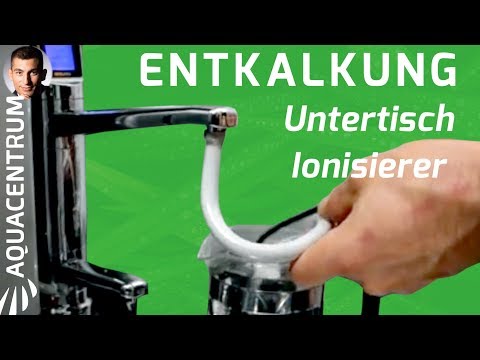
Descaling under-sink ionizer | EOS Revelation
Undercounter water ionizers present a particular challenge, as almost all undercounter water ionizers (Tyent UCE) 9000, Ionquell Delphi, …) have serious difficulties with hard water.
Almost all of them, because of that AquaVolta® EOS Revelation II Water Ionizers an exception is:
After the ON-OFF operating sensor has been touched to switch it off, it reverses the electrode polarity for a few seconds and flushes the cleaning water out of the device.
However, this is not sufficient to keep both outlets free of limescale in the long term; therefore, descaling, ideally all of them, is necessary. 2- to be carried out over 6 months. The video explains exactly what you should pay attention to.
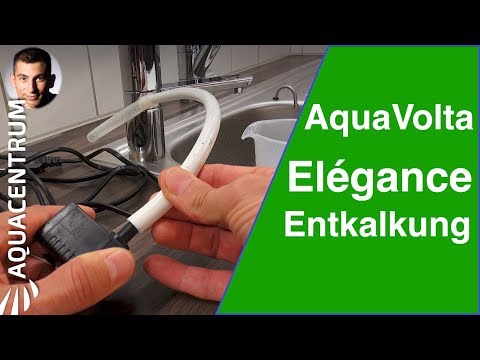
Descaling under-sink ionizer | AquaVolta® Elegance
Although the AquaVolta® Elégance has a sophisticated descaling concept, namely the automatic flow reversal after every change in the polarization of the electrodes, and this is also the case with the AquaVolta® Elegance It is necessary to descale the under-sink water ionizer regularly.
Depending on usage, descaling can be necessary for all 4 Weeks until 12 This may take months. It depends on various factors, which are outlined below:
- Water hardness or the lime content of tap water
- The set water flow: the slower, the stronger the end result, the faster the calcification of the alkaline hydrogen water outlet
- The level set, the stronger the electrolysis power, the faster the calcification
- The total amount of alkaline water produced daily
The video on the left is very informative.
Descaling a water ionizer with a flow dial
If you own one of the water ionizers listed below, be sure to watch this video.
In short: Make sure that the pump can pump the citric acid solution into the filter. The rotary control should therefore always be set to OFF, i.e. in the off position. The following water ionizers have a flow control dial and are descaled analogously:

Descaling ionizer with flow regulator | Nexus X Blue > The predecessor of the AquaVolta® Moses 7
This video shows the individual descaling steps that must be observed, especially for water ionizers with flow regulators.
According to the latest experience, you can only descale in one pass, you don't have to turn the ionizer on and off between descaling.
The duration can also vary depending on usage and degree of calcification, up to... 4 The soaking time can be extended by several hours. Please replace the citric acid solution after one hour if there is heavy limescale buildup.
Descaling does not harm the water ionizer in any way. It's exactly the opposite, descaling is good for any water ionizer as long as you use citric acid and not acetic acid.
Descaling a water ionizer with an ON-OFF solenoid valve
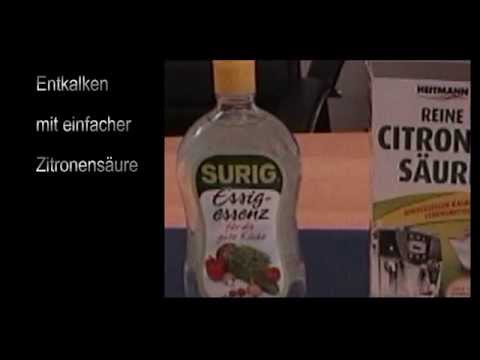
Most of the water ionizers that our customers mainly buy are the ones with a solenoid valve. These are ideal for permanent installation with a T-piece. At the push of a button, the water ionizers produce the last set ionization level because you remember it. In addition, the flow rate is fixed, which ensures that even small children can and will operate the system safely. We have Evidence videos.
The following water ionizers are among the models that have an ON-OFF solenoid valve:
General descaling instructions for a water ionizer
Karl Heinz Asenbaum has in the last 10 For years, he has made alkaline hydrogen water known in Germany, Austria and Switzerland through his numerous publications.
Let's see what he has to say on the subject of limescale and descaling a water ionizer.
Don't be fooled by the numerous statements from the reverse osmosis lobby and the beverage and pharmaceutical lobby that reverse osmosis water, i.e. water low in minerals, is the only true thing.
All living things, including plants and trees, depend on mineral salts in water and their transport through water. Minerals cannot be harmful!
With most ionizers, the flow rate at the outlet for the alkaline hydrogen water decreases in the first few stages, depending on the lime content, the flow rate, and the selected ionization level. 1 12 months from
Therefore, you should descale these ionizers every two to four months, depending on the limescale content and usage.
We recommend descaling all water ionizers every two to six months, as limescale can build up on the valves and outlet. Depending on usage and water hardness, descaling may not be necessary until after... 6Descaling may be required every 12 months. Descaling also disinfects your water ionizer and should therefore be carried out weekly in public places.
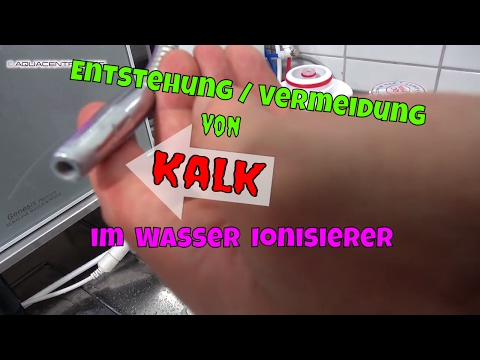
Ionizer | When is the right time to descale?
You can tell when the time is right for descaling by the volume flow ratio of the alkaline water to the acidic wastewater. After decalcification, just as much alkaline water is produced as acidic wastewater. The more calcified the outlet of the ionizer is, the less alkaline water flows through, so the wastewater volume flow increases depending on the degree of calcification and is a good indicator.
In the AquaVolta® EOS Water Ionizers (AquaVolta® EOS Genesis, AquaVolta® EOS Revelation Undertable ionizer, AquaVolta® EOS Touch It's a little different: EOS water ionizers produce only half as much wastewater as alkaline water. Therefore, the right time to descale an EOS water ionizer is when the same amount of wastewater comes out of the drain hose and the alkaline outlet. 1:1 Water comes out.
Descaling is really easy to carry out once and practiced the next few times and is shown in our numerous videos.