
For the past few weeks, we've been receiving numerous calls with the same question. Videos, forums, and groups are claiming that the membrane in hydrogen boosters and inhalers releases PFAS, or "perennial chemicals," into drinking water or even the hydrogen gas you breathe. The concern is understandable: PFAS are a real environmental problem, and the membrane in our devices is indeed made of a fluorinated plastic. Because these claims are now unsettling many customers, we are addressing this issue. The twelve most common ones are listed individually below..
We analyzed the membrane manufacturer's data sheets, current assessments from EU authorities, and the relevant literature on the aging of such membranes. Here you will find our findings, including sources, verifiable calculations, and insights that research has yet to reveal.
The short answer
- The membrane (Nafion) 117) is classified as a PFAS according to current definitions. It is a solid, water-insoluble plastic and does not dissolve in water.
- The European Chemicals Agency sees the main concern regarding fluoropolymers in The Brand, processing and disposal. Small, mobile PFAS enter rivers and the air there.
- The membrane ages during electrolysis. Industrial stress tests have primarily measured fluoride, while fuel cells have also detected small fluorinated fragments such as trifluoroacetic acid (TFA). Our research did not uncover any published measurements of household appliances.
- Our example calculation for a filling of the H2 TurboBased on the membrane opening we measured, and under the assumptions mentioned there, this results in a calculated value of approximately one 650th of the drinking water limit for fluoride and approximately one 250th of the guideline value for TFA set by the German Federal Environment Agency. This is an estimate, not a measurement; whether it overestimates or underestimates the actual release remains unclear.
- What can primarily enter the water in this process is the fluoride ion, which is also found in tea and mineral water. Chemically, it is the same ion as in the fluoridated drinking water of other countries. The difference lies in the quantity, and hexafluorosilicic acid, which is often added there, is not formed in the membrane.
- The polymer does not evaporate. Whether traces of degradation products enter the gas of an inhaler via the finest droplets has not been measured.
- A device without a membrane is not automatically the better choice: Without separation, substances produced on the oxygen side can also enter the drinking water. Whether this is the case with a specific device must be measured on the device itself.
- What you can specifically do is explained in the checklist at the end.
In this article: What PFAS are · What Nafion is · What the EU says · What happens inside the device · Sample calculation · Classifying fluoride · Inhalers · Twelve claims put to the test · What remains open · checklist · Frequently asked questions
What PFAS are and why they are a cause for concern
According to the German Federal Environment Agency, PFAS (per- and polyfluoroalkyl substances) are a group of over 10.000 These are artificially produced substances. What they have in common is the carbon-fluorine bond, one of the strongest bonds in chemistry. Many PFAS are therefore hardly biodegradable in the environment.
The term encompasses a wide variety of substances. On the one hand, there are small, water-soluble molecules such as PFOA, PFOS, or TFA. These enter drinking water via groundwater, and some accumulate in the body. On the other hand, there are fluoropolymers such as PTFE (known as Teflon) or Nafion: enormous chain molecules that exist as solid films or coatings. For an assessment, these groups must be distinguished.
Since 12. January 2026 In Germany, a limit value of [value] applies to drinking water. 0,1 micrograms per liter for the sum of 20 PFAS. From 2028 A stricter value is added. 0,02 µg/l for four particularly critical substances added.
What Nafion is
Nafion is the brand name of a membrane currently manufactured by Chemours (formerly DuPont). Chemically, it consists of a backbone similar to PTFE with fluorinated side chains, at the ends of which are sulfonic acid groups. Protons migrate through the membrane via these groups. This is why it is called a proton exchange membrane (PEM).
In a hydrogen generator, the membrane separates the two sides of the electrolysis process. Hydrogen is produced on one side, and oxygen on the other. The hydrogen enters the water or the gas hose, while the oxygen is discharged separately.

According to the data sheet, Nafion 117 period 0,18 mm thick and weighs 360 g per square meter. It is a chemically stabilized type which, according to the manufacturer, releases significantly less fluoride than unstabilized material. Approximately two-thirds of its mass is fluorine (our calculation based on the molecular formula).

These devices from our product range, for example, use PEM cells:
- The Aquavolta® H2 Turbo 3.0 It enriches drinking water. According to the device data, it uses a Nafion 117 type membrane; we will clarify whether it is original material (more on this in the next section).
- The Pulmovolta® Cavallo 1000 It's an inhaler. Its instructions also mention Nafion. 117.
- The Pulmovolta® H2K 3000 is an inhaler with a large PEM cell.
Is Nafion a PFAS?
Yes. According to the OECD definition of 2021 Any substance with at least one fully fluorinated CF₂ or CF₃ group is included, and that applies to Nafion. But for you, a different question is more important: Do PFAS from this film leach into your water or the air you breathe, and if so, how much?
Original Nafion or equivalent membrane: Does it make a difference?
Nafion N117 is a specific membrane from Chemours. Besides this, there are now membranes with similar dimensions from other manufacturers, including many from China, as well as composite membranes reinforced with PTFE fabric. Almost all of these membranes belong to the same class of materials as Nafion: they are perfluorinated sulfonic acid polymers (PFAS). Therefore, the origin of the membrane does not change the question of whether it contains PFAS or not. An alternative of this type is also a PFAS.
There are differences in quality. How well a membrane is chemically stabilized, how many manufacturing residues it contains, and how quickly it ages depend on the manufacturer and the manufacturing process. We are currently clarifying with the device manufacturer which membrane manufacturer supplies the membrane in the device. H2 Turbo Similar dimensions do not necessarily mean the same properties. Our calculation below uses the upper limit of the measured values from the literature. We cannot rule out the possibility that a membrane of unknown origin lies above this limit; the transferability of the material data remains uncertain. Therefore, we also show what would result with a tenfold increase in output.
Where the EU authority sees the main problem with fluoropolymers
The European Chemicals Agency (ECHA) is preparing to restrict almost all PFAS. Its Risk Assessment Committee (RAC) met on 2. March 2026 It adopted its opinion, which states that high-molecular-weight fluoropolymers are not water-soluble and do not meet the criteria for mobility. The committee cites the following as its main concern:
- Emissions of small, non-polymeric PFAS during the The Brand the fluoropolymers,
- Residues and decomposition products during the application with heat, for example during sintering or extrusion,
- Emissions in the Waste phase, for example, in cases of poor combustion.
The Chemours plant in Fayetteville, North Carolina, illustrates the impact of emissions during manufacturing. Fluorinated byproducts from there entered the Cape Fear River, which supplies drinking water to the city of Wilmington. 344 Researchers found people from Wilmington 2017 and 2018 including the "Nafion by-product" 2“, a by-product of Nafion production, in more than 85 Percent in the blood. This study concerns the exposure from a chemical plant. It did not examine emissions from finished hydrogen devices.
The industry often refers to fluoropolymers as "polymers of low concern." The RAC (Research Committee on Chemicals and Biotechnology) points out that there are no adopted criteria for this term and that focusing solely on the finished product ignores manufacturing and disposal. A group of independent environmental chemists led by Rainer Lohmann... 2020 to the same conclusion. We therefore do not adopt this label.
For fluoropolymers in fuel cells and electrolyzers, the RAC proposes a transition period of 13,5 Years after the restriction came into effect. This is not yet legally binding: The Second Committee on Economic Affairs and Control (SEAC) will issue its final opinion at the end of [year]. 2026 They submit their findings, then the EU Commission and member states decide.
What happens inside the device
Does the membrane dissolve in water?
No. Chemours states in technical data sheet T-01 that Nafion is not biodegradable, contains no extractable material, and is not affected by freshwater. This is a manufacturer's statement. We have no independent measurements regarding storage in water.
What happens when electricity flows
During electrolysis, small quantities of highly reactive particles, such as radicals, are produced at the electrodes. These attack the membrane at specific points. This degradation process is well-studied because it limits the lifespan of fuel cells and electrolyzers.
Engineers measure the released fluoride as a measure of aging. Fluoride is a simple ion and not itself a PFAS. An investigation on an electrolysis cell with Nafion 117 found in a 100-hour stress test peak values of 0,83 micrograms of fluoride per hour and square centimeter of membrane, measured according to 25 Hours. Towards the end of the test, the value dropped to 0,03 0,27For the specialist literature as a whole, the authors cite a range of 0,01 2,0 micrograms. Several research groups observed an increased release at the beginning, which the authors attribute, among other things, to residues from manufacturing.
Besides fluoride, small fragments of the membrane can be formed. Researchers from 3M found 2021 in the wastewater of fuel cells in stress tests (90 °C(dry gases) sulfate, trifluoroacetic acid (TFA), and fragments of the side and main chains were detected by mass spectrometry. The amount of TFA in the Nafion membrane tested was approximately one-tenth of the amount of fluoride. These fragments are small PFAS. Therefore, the statement that a PFAS molecule can never emerge from a Nafion membrane is untenable.
A study by 2025 The circulating water of a large megawatt-range PEM electrolysis plant was analyzed during the first two weeks of operation. The analysis was performed using the US standard EPA method. 1633 The researchers did not detect any of the PFAS measured by this method. 40 specific PFAS, not the entire group of substances; a lack of detection applies only to these substances and the respective detection limit.
The orders of magnitude: an example calculation
In our research, we found no published PFAS measurements on small hydrogen boosters. However, we can estimate the order of magnitude. All figures in this section are EstimatesNo measurements were taken on our devices. The emission rates are derived from tests conducted under different conditions. Whether the calculation overestimates or underestimates the actual emission has not been measured. The Turbo operates with significantly less current per unit area than the test cells. However, the emission rate also depends on temperature, impurities in the water, and operating cycles; therefore, the current density alone cannot reliably determine whether the calculation is too high or too low.
We measured the membrane area. In an earlier version of this article, we had 10 cm² assumed. At the bottom of the bottle, the opening through which the water touches the cell has a diameter of cm². 21 22 mm, These are 3,5 3,8 cm². Beneath the opening lies first an electrode made of perforated sheet metal, and only below that the membrane. By eye, they are 30 40 Percent of this sheet is open. The water therefore only touches the membrane on a portion of the surface.
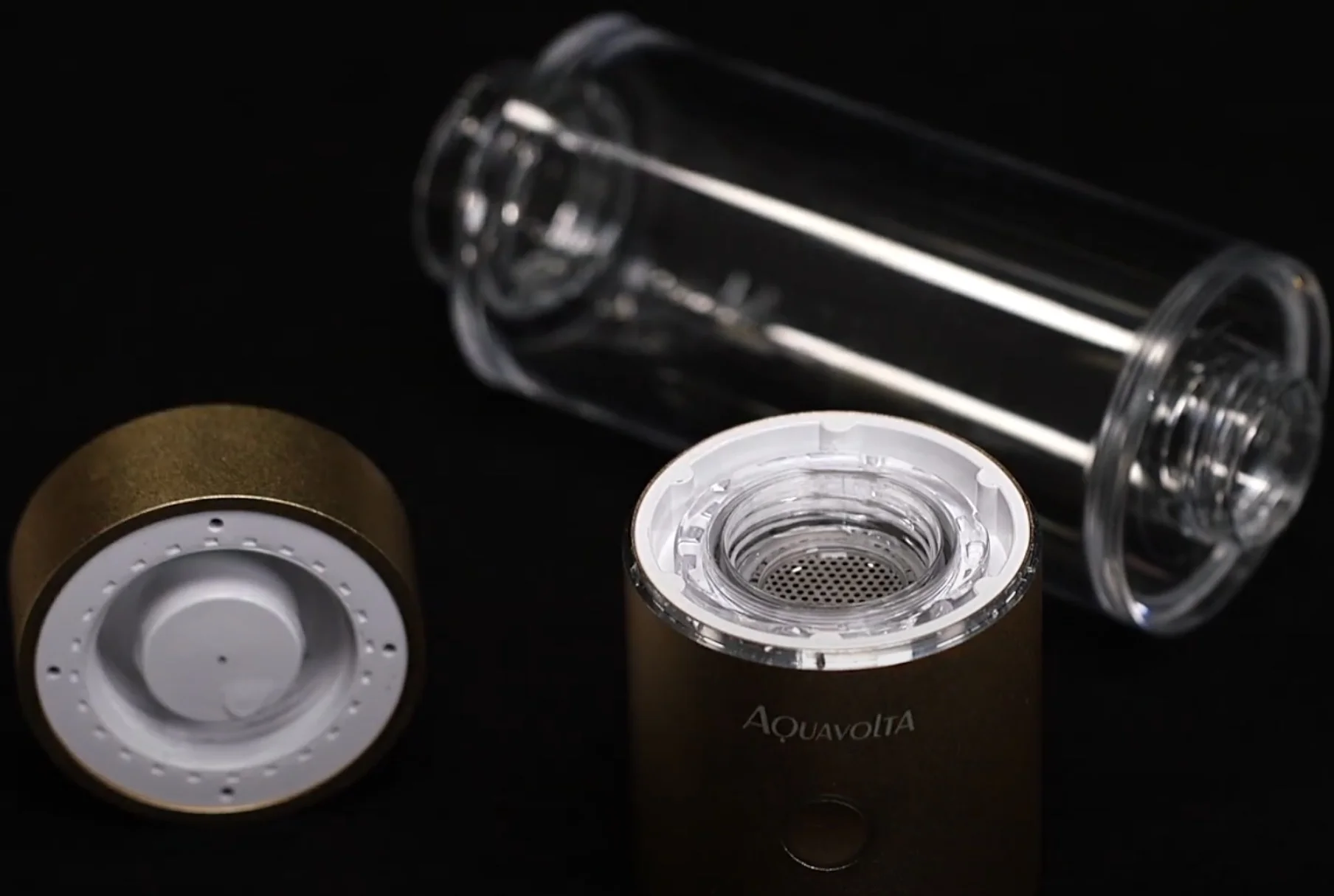
Assumptions for the H2 Turbo 3.0:
- Membrane area 3,8 cm², meaning the entire opening with the larger measured value. That's our main calculation. The release rates from the literature refer to the entire active area between the electrodes, not just the part that comes into direct contact with water.
- For comparison: only the open area of the perforated sheet, with 40 Percent, approximately 1,5 cm². Whether this smaller area is the actually effective one is not confirmed; the main calculation is decisive.
- Fluoride release 2,0 µg per hour and cm², which is the upper limit of the literature range. According to the device data, the Turbo operates at a maximum of... 1 Ampere, that's what they are called 3,8 cm² approximately 0,26 A per cm². The test cell above was filled with up to 3 A per cm² operated.
- All the fluoride ends up in the drinking water, even though some of it is produced on the oxygen side.
- One filling: 270 ml, 5 Minutes running time. The 10The -minute mode is intended for larger bottles; with the same amount of water, the value would double.
- TFA: We will temporarily assume the ratio of approximately... 1 zu 10 This data comes from a fuel cell study using a different Nafion membrane and different operating conditions. Whether it applies to electrolysis at room temperature has not been investigated; therefore, the TFA figures are even more uncertain than the fluoride figures. Further potential fragments cannot be quantified.
| Size | on account | Result | comparative value |
|---|---|---|---|
| Fluoride per filling (entire opening) | 2,0 µg × 3,8 cm² × 5/60 h | approx. 0,63 µg in 270 ml ≈ 2,3 µg/l | Limit value for drinking water 1.500 µg/l, that is, about one 650th |
| Fluoride per filling (open cavity area only) | 2,0 µg × 1,5 cm² × 5/60 h | approx. 0,25 µg in 270 ml ≈ 0,9 µg/l | about one 1.600ths of the limit |
| TFA per filling (entire opening) | about one tenth of the fluoride amount | approx. 0,23 µg/l | Guideline value of the Federal Environment Agency 60 µg/l, that is, about one 250th |
| TFA per filling (open hole area only) | about one tenth of the fluoride amount | approx. 0,09 µg/l | approximately one 650th of the conductivity |
| Calculated fluoride release per year (full opening) | 3 Daily fillings, 365 Days | approx. 0,7 mg | The membrane contains approximately [number] on this surface 90 mg Fluorine, that's less than 1 Percent per year |
How much distance remains if a membrane is inferior to those studied in the literature? Even with a tenfold increase in the release rate, the fluoride level in the main calculation would be approximately... 23 µg/l, that's about one sixty-fifth of the limit. For TFA it would be approximately 2,3 µg/l, approximately one 25th of the conductivity value.
Two caveats are necessary. Fluoride is not a PFAS, so comparing it to the fluoride limit says nothing about PFAS. And TFA is not among the 20 PFAS, for which the German limit value applies; the Federal Environment Agency has established a guideline value for these. What other PFAS, and in what quantities, might be emitted from a household appliance has not been investigated.
Classifying fluoride: How much is a lot?
Fluoride occurs naturally almost everywhere. Seawater contains approximately 1,3 milligrams per liter, so about 1.300 micrograms. According to the German Federal Institute for Risk Assessment (BfR), black tea is particularly rich in fluoride. Natural mineral waters are permitted to contain up to... 5 mg contained per liter; the content is above 1,5 mg For each liter, the label must state that the water is not suitable for regular consumption by infants and children under seven years of age. A limit of [value missing] applies to drinking water. 1,5 mg per liter. According to the BfR, over 90 Percent of the drinking water samples tested in Germany less than 0,3 mg per liter.
Our main bill for a turbo fill comes to around 0,0023 mg per liter. This is not a free pass: Fluoride is harmful in larger quantities, which is why there is a limit. However, the calculation shows the order of magnitude.
Fluoride is not the same as hexafluorosilicic acid. In some countries, such as the USA, Ireland, and parts of England, fluoride is added to drinking water, often in the form of hexafluorosilicic acid (H₂SiF₆). Some people have fundamental concerns about this fluoridation of drinking water. In Germany, drinking water is not fluoridated. What a membrane can release as it ages is the simple fluoride ion, which is measured in the scientific literature as a measure of aging. Hexafluorosilicic acid is not produced in this process and is not added. We explain what this substance is and where fluoridation actually takes place in the article. Fluoride is not the same as hexafluorosilicic acid.
We remain cautious regarding TFA. TFA is a PFAS and is practically non-biodegradable in the environment. The ECHA's Risk Assessment Committee decided in June 2026 It has been proposed to classify TFA as toxic to reproduction (category 1B). The Federal Environment Agency maintains its health guideline value of 60 µg per liter is still considered sufficiently protective. The fact that our estimate is far below this level is not a substitute for a measurement.
And what about the hydrogen gas in the inhalers?

Inhalers use significantly more electricity than a drinkable energy booster. Cavallo 1000 generates 667 ml Hydrogen per minute. According to Faraday's law, this corresponds to... 25 °C approximately 87 Ampere, at H2K 3000 with 2.000 ml approximately per minute 260 Amperes. We did not measure how this is distributed across cells and membrane area.
We know this:
- The polymer does not evaporate. Nafion is a solid plastic. According to the manufacturer, decomposition in air only begins at around... 280 °C, health-relevant fumes occur above 250 °C In operation with liquid water, the temperatures are much lower. However, decomposition by heat is a different process than degradation by electrolysis.
- The degradation products were measured in the water. Fluoride, sulfate, and TFA are water-soluble and exist as ions in water. In the studies mentioned, they were found in the wastewater from the cells. In the case of the inhaler, this corresponds to the tank water and the water carried along by the hydrogen from the cell.
- The gas bubbles through the humidification container.before you inhale it. Water-soluble substances and droplets can remain there. Our devices do not measure how much.
It remains unclear whether traces of polymeric particles or dissolved degradation products can reach the nasal cannula via minute droplets (aerosol). Research in this area is still in its early stages. The EU project UPeM, with the participation of Fraunhofer CSP, has been developing this research since March. 2026 Only standardized procedures for measuring PFAS in liquids, gases, and aerosols from electrolyzers and fuel cells are being developed. The project runs until August. 2028.

Another example calculation, again based only on assumptions: With 2,0 µg per hour and cm² and approximately 87 cm² area (at 1 A per cm²) would result in Cavallo at 30 minutes daily for approximately three months 8 mg Fluoride, assuming it all remained in the tank water. The amount of fluoride present has not been measured. The tank water is not drinking water anyway, and the instructions stipulate that it should be changed at least every three months.
The most common claims – and what's true about them
In videos, forums, groups, shop descriptions, and customer conversations, we repeatedly encounter the same statements. Almost all of them conflate two things that must be distinguished: the solid plastic of the membrane and small, water-soluble PFAS molecules. We examine twelve claims individually, with figures, sources, and an everyday comparison. The headings are concise summaries of what we hear, not direct quotes from specific individuals or vendors. Those who cautiously demand that devices be tested are correct; we address this in section [number missing in original text]. 12 .
| claim | Our classification |
|---|---|
| The membrane releases PFAS into the drinking water. | Partly true, the quantity matters |
| PFAS are inhaled along with the hydrogen. | Not measured; evaporation unlikely, droplets open |
| Nafion is the same as Teflon. | Related, but not the same |
| Nafion is a PFAS, so it's as dangerous as PFOA. | The first part is correct, the end is not. |
| Perpetual chemicals accumulate when drinking. | Depending on the material: years or days |
| “PFAS-free” devices are safer. | Depends on what's inside instead. |
| The safest option is a device without a membrane. | Not documented; the membrane has a separation function. |
| Every membrane is poison. | No |
| The EU will soon ban all PFAS, including Nafion. | Not yet decided, transition period proposed |
| Membranes from China are toxic. | Not proven in such general terms |
| The membrane fluoridates the water, similar to drinking water fluoridation. | No, several hundred times less |
| Without measurement, the device is dangerous. | Unknown does not mean dangerous or safe. |
1"The membrane releases PFAS into the drinking water."
Partly correct. The quantity is crucial.
In stress tests on fuel cells, researchers found small fluorinated fragments, primarily trifluoroacetic acid (TFA), in the wastewater alongside fluoride. This amount comprised about one-tenth of the fluoride. Therefore, the statement "nothing ever comes out of the membrane" would be incorrect, and we do not make this statement. We found no measurements on household appliances during our research. Our example calculation for a filling of the H2 Turbo The measured membrane opening yields approximately... 0,23 µg per liter. That is about one 250th of the guideline value set by the German Federal Environment Agency. 60 µg per liter. Even if the membrane released ten times more than in the studies, it would still only be one-twentieth. Theoretically, the membrane loses less than this amount per year. 1 Percent of their fluorine.
From everyday life: An eraser loses a little bit of material with every use. Even someone who only erases a few lines a day will still have almost completely intact it after years. The question is never whether something will come off, but how much.
2"You inhale PFAS along with the hydrogen."
Not measured. It is unlikely that dissolved substances evaporate; whether the finest droplets carry them away is unclear.
The polymer itself does not evaporate: According to the manufacturer, decomposition in air only begins at around 280 °CThe devices operate with liquid water at much lower concentrations. The known degradation products fluoride and TFA were found in the water in the studies, not in the gas. TFA is a very strong acid and exists almost entirely as an ion in water. Ions do not evaporate. It remains unclear whether the finest droplets (aerosol) carry traces of it, as dissolved substances can be transported by droplets. The inhalers have a humidification chamber through which the gas bubbles; whether and how much it retains was not investigated for our devices. We found no published measurements on inhalers; the EU project UPeM is still developing the measurement methods for gases and aerosols.
From everyday life: Steam rises from a pot of salted pasta water. The steam itself is not salty; the salt remains in the pot. However, when the water splashes, small droplets of salt water land on the stovetop. This splashing is precisely the open point.
3"Nafion is the same as Teflon."
Related, but not the same.
The backbone of Nafion is PTFE, the material behind the brand name Teflon. Nafion also carries side chains with sulfonic acid groups. These absorb water and conduct protons, which is why the membrane functions at all. A frying pan is often used as a comparison: The German Federal Institute for Risk Assessment (BfR) considers PTFE-coated cookware to be safe when used properly. According to the BfR, swallowed particles of a scratched coating are excreted undigested. The situation becomes critical when the empty pan is overheated for approximately... 360 °CA membrane in water never reaches such temperatures. However, this can only be extrapolated to a limited extent: In the membrane, it's not about heat, but about chemical degradation during electrolysis, and Nafion doesn't behave like PTFE. The environmental question remains the same for both: production and disposal.
From everyday life: Siblings share the same last name, but not the same characteristics. Those who know about frying pans know some things about membranes, but not everything.
4"Nafion is a PFAS, so it's as dangerous as PFOA and PFOS."
The first part is correct, the end is not.
According to the OECD definition, Nafion is a PFAS. However, according to the German Federal Environment Agency, this term encompasses over 10.000 Substances. PFOA and PFOS, the well-known problematic substances in groundwater, are small, water-soluble molecules that accumulate in the body. Nafion is a huge, water-insoluble chain molecule. The European Chemicals Agency states that such fluoropolymers do not meet the criteria for mobility. Their main concern is their manufacture, processing, and disposal. It remains true that Nafion is also hardly biodegradable in the environment. Therefore, an old device should not be disposed of with household waste.
From everyday life: In chemistry, "alcohol" is a collective term. Ethanol is found in wine, methanol can cause blindness. Both are called alcohols. No one would conclude from this that a glass of wine has the same effect as methanol.
5"Permanent chemicals accumulate in the body when consumed."
It depends heavily on the material: for some it's years, for others days.
The European Food Safety Authority (EFSA) estimates a half-life of approximately five years in humans for PFOS and two to four years for PFOA. These substances do indeed accumulate. TFA, the most important potential degradation product of the membrane, behaves differently: According to the German Federal Institute for Risk Assessment (BfR), it is excreted unchanged and predominantly via the kidneys, with a half-life of two to three days. Fluoride is partly excreted and partly incorporated into bones and teeth. The solid polymer is a huge molecule and behaves differently than small PFAS; however, no conclusions can be drawn from this regarding potentially abrasion-prone particles in devices. A short half-life does not mean that TFA is harmless: It is persistent in the environment, and the ECHA's Risk Assessment Committee has proposed classifying it as toxic to reproduction. However, this does mean that the statement "PFAS remain in the body forever" is not true for TFA.
From everyday life: Whether a bathtub fills up depends not only on the water supply but also on the drain. With PFOS, the drain is almost blocked. With TFA, it is wide open.
6"Devices with PFAS-free technology are safer."
That depends on what's installed instead.
Some manufacturers are now advertising a "PFAS-free" membrane. "PFAS-free" indicates what's missing, not what's present. Fluorine-free proton membranes, such as those based on hydrocarbons or containing inorganic components, are being developed in research projects, for example, the EU project FASTCH2ANGE, which involves the Fraunhofer ISE. They haven't been tested as long as PFAS membranes. We haven't found any published comparative measurements of drinking water from household appliances for either type. Therefore, we're not saying that such appliances are inferior. We're saying that without a data sheet and analysis, the advantage cannot be verified. Sometimes, "without a PFAS membrane" simply means "without a membrane." More on that in the next point.
From everyday life: "Fat-free" is also written on gummy bears, and it's true. It says nothing about the sugar content.
7"The safest device is one without any membrane at all."
Not documented. The membrane has a separation function that is absent in devices without a membrane.
During electrolysis, different substances are produced at two electrodes: hydrogen at one, oxygen at the other. If chloride is present in the water, as is the case in almost all tap water, chlorine can also be produced on the oxygen side, which then reacts in the water to form hypochlorite. Depending on the electrode material and voltage, ozone and chlorate may also be produced. This chemical process is used in specific applications, such as disinfection. A PEM membrane separates the two sides: the hydrogen enters the drinking water, while the gas from the oxygen side is removed separately. Without this separation, substances produced on the oxygen side can also enter the drinking water. The amount produced depends on the device, the current, and the water. We do not have a reliable safety comparison between devices with and without a membrane, and we have found very few independent measurement series for simple bottles without a membrane. Whether a specific device releases byproducts into the drinking water must be measured on that particular device.
From everyday life: Cooking without a range hood: What happens in the pan stays in the kitchen. If water from an electrolysis device has a noticeably chemical smell, like a swimming pool, do not drink it. Conversely, odorless water has not been tested for byproducts.
8"Every membrane is poison."
No.
Membranes are used in many applications where purity is crucial: in reverse osmosis systems for drinking water, in dialysis machines that purify patients' blood daily, and in fuel cells. Whether a material is harmful depends on what and in what quantity it releases. There are established limits and guideline values for this. Simply labeling it a "poison" doesn't answer this question. Based on current knowledge, the answer for PEM membranes is: fluoride and small amounts of TFA, which, in our calculations, are far below the threshold values.
From everyday life: A coffee filter is also a membrane. Without it, you'd have coffee grounds in your cup.
9"The EU will soon ban all PFAS, including Nafion. This shows how dangerous it is."
Not yet decided. And the reason is different than many people think.
The EU is considering restricting almost all PFAS. The ECHA's Risk Assessment Committee (RAC) met on 2. March 2026 adopted his statement. For fluoropolymers in fuel cells and electrolyzers, he proposes a transition period of 13,5 Years after it came into force. The second committee (SEAC) intends to issue its final opinion at the end of 2026 The proposals will be submitted, after which the EU Commission and member states will decide. The main reason for the restriction is the device's longevity in the environment throughout its entire life cycle, including production and disposal. It is not based on any finding that a finished device poisons its user.
From everyday life: The planned ban on new combustion engine cars doesn't mean your current car will blow exhaust fumes into the interior. It's about the total amount of emissions released into the environment.
10"Membranes from China are toxic."
This has not been proven in general terms.
Most alternatives to the original Chemours membrane are also PFSA membranes from the same material class. How well a membrane is stabilized, how many manufacturing residues it contains, and how quickly it ages depend on the individual manufacturer and their quality control. This applies to factories in Asia as well as in Europe and the USA. We found no independent comparative measurements for household appliances. Which membrane manufacturer supplied the membrane in the H2 Turbo We will clarify the origin with the device manufacturer.
From everyday life: The baker decides whether a loaf of bread is good, not the country. Ask for the data sheet, not the flag.
11"The membrane fluoridates the water, just like drinking water fluoridation."
No. The difference is several hundred times greater.
Where drinking water is fluoridated, for example in Ireland or parts of England, the target value is around 0,6 1 Milligrams of fluoride per liter. Our calculation for a turbo fill comes to approximately... 0,0023 mg per liter, which is several hundred times lower. Hexafluorosilicic acid is often mentioned in this context. It is used for fluoridation and, according to a scientific committee of the EU Commission, decomposes rapidly and almost completely into fluoride and silicic acid in drinking water. It is not formed in the membrane. More on this in our article. Fluoride is not the same as hexafluorosilicic acid.
From everyday life: A pinch of salt in pasta water doesn't make seawater. Same substance, completely different quantity.
12"As long as there are no measurements, the device is dangerous."
Unknown does not mean dangerous or safe. The demand for measurements is justified.
It is true that we found no published, device-specific measurements of PFAS in drinking water or in the gas from small appliances during our research, neither for our appliances nor for those of other manufacturers. This does not imply any danger, but rather an open question. Until measurements are available, we can only estimate the levels using the upper end of the measured values from the literature and an additional factor of ten. The result is shown in the table above. It indicates an order of magnitude, not a verified upper limit. As soon as measurements are available, we will add them here.
From everyday life: Anyone who hasn't examined the soil before building a house doesn't know if it's load-bearing. But they also don't know if it isn't. The answer is a soil survey, not fear or ignoring the problem.
What we don't yet know
- In our research, we found no published measurements of PFAS in the product water or in the gas of small boosters and inhalers, neither for our devices nor for those of other suppliers.
- At the H2 Turbo We measured the opening above the membrane, not the electrochemically active area. The degradation rate under household conditions was not measured.
- Which manufacturer supplied the membrane in H2 Turbo We will clarify the origin with the device manufacturer.
- The membrane manufacturer explicitly requests consultation in its data sheets regarding medical applications.
- The EU restriction has not yet been decided. We are monitoring the progress of the proposed deadline for electrolyzers and what the UPeM project is measuring.
This could be clarified with comparative analyses: source water and product water from new and used devices, under defined operating conditions, with a substance list that includes TFA. For inhalers, the emitted gas along with any entrained droplets would also need to be examined. We currently do not have such test reports. We will update this article when we receive new measurement data.
Checklist: What you can do now
We do not conduct measurements on our devices. These points are derived from the instructions and from studies on membrane aging. The first six apply to devices with a PEM membrane, the last four apply to any hydrogen device and to your tap water.
- Soak and rinse new appliances first. Several studies showed elevated fluoride release at the beginning of treatment, partly due to manufacturing residues. As a precaution, we recommend the following with the new product: H2 TurboFill the bottle with warm water, let it stand for half an hour, and then discard the water. Afterward, also discard the first two to three fillings after switching it on. This is our precautionary recommendation, not a tested procedure: duration, temperature, and number of fillings have not been measured. Please also refer to the rinsing instructions in the manual.
- Change the tank water according to the instructions. At the Cavallo The instructions require a complete water change at least every three months, even if the unit is not in use, and a change when the "Purewater" indicator lights up red. H2K It reports "Change Water" and monitors water quality with a TDS sensor. This sensor does not provide information about individual PFAS.
- Use only double-distilled water in inhalers. The instructions state this. According to the literature, impurities in the water, such as metal ions, accelerate the chemical attack on PEM membranes.
- Demineralization cartridge. The demineralization cartridge for Cavallo, H2K According to the product description, the inspirator removes cations and anions from the tank water and primarily serves to improve water quality within the device. Its protective effect against PFAS or other membrane degradation products has not been investigated and therefore cannot be inferred.
- Do not drink the humidifier water and renew it regularly.
- Take old appliances to the recycling center. Electrical appliances should never be disposed of with household waste. According to the manufacturer, burning fluoropolymers without exhaust gas purification produces hydrogen fluoride; laboratory tests have also shown the production of short-chain PFAS. The ECHA explicitly cites the waste phase as one of its main concerns.
- Ask about it when you buy from any supplier. Which membrane is installed (with datasheet)? Is the gas from the oxygen side vented separately? Is there an independent analysis of the product water? We also ask our suppliers these questions.
- Pay attention to the smell. If water from an electrolysis device has a noticeably chemical smell, similar to a swimming pool, do not drink it and contact the manufacturer to determine the cause. The smell alone does not reveal the substance or its origin, and odorless water is therefore not tested.
- Know your own tap water. You can obtain the analysis results from your water supplier. Since January 2026 Does the limit apply there to the sum of 20 PFAS. Anyone who wants to know for sure should have it measured at an accredited laboratory and clarify beforehand which substances are being tested; TFA is not included in every PFAS package.
- If you have concerns about fluoride: In Germany, drinking water is not fluoridated. Those who still wish to filter it need reverse osmosis or special fluoride filters; ordinary activated carbon hardly retains fluoride. Details in the article. Fluoride is not the same as hexafluorosilicic acid.
Conclusion
The membrane is a PFAS. It does not dissolve in water, and the polymer does not evaporate. Electrolysis causes it to age, and stress tests produce fluoride and small fluorinated fragments. Our example calculation for the H2 TurboWith the measured opening above the membrane, the levels of fluoride and TFA fall well below the limit and guideline values, even at a tenfold release rate, according to their assumptions. These assumptions are not confirmed by the device. Device-specific measurements in drinking water and inhalation gas are lacking, both for our devices and, according to our research, for all others. The European Chemicals Agency considers the main concern to be fluoropolymers in the manufacture, processing, and disposal of these substances.
Most claims circulating conflate the solid plastic and small, water-soluble PFAS. Separating the two reveals the following: Something is leaching from the membrane, which, according to current knowledge, is fluoride and a small amount of TFA, far below the limit and conductivity values in our calculations. Nevertheless, it must be measured.
Do you have questions about your device? Call us on weekdays from 9 18 Uhr.
Frequently asked questions
Is Nafion the same as Teflon?
Not quite. The backbone is similar to PTFE (Teflon). Nafion additionally has side chains with sulfonic acid groups that absorb water and conduct protons.
Does the membrane emit PFAS when the device is just sitting idle?
According to the manufacturer, Nafion contains no extractable material and is not affected by fresh water. The chemical degradation described in studies occurs via reactive particles generated during operation. We have no measurements of our devices when they are idle.
How much fluoride is in a filling of the H2 Turbo?
We didn't measure it. Our example calculation using the upper literature value and the measured opening of 3,8 cm² yields approximately 2,3 micrograms per liter zusätzlich to the fluoride already present in the bottled water. The limit for drinking water is... 1,5 milligrams per liter, so about 650-times higher. Seawater contains approximately 1,3 milligrams per liter.
Is the fluoride from the membrane the same as that used in drinking water fluoridation?
The fluoride ion is chemically the same. What differs is its origin and quantity: The membrane can release fluoride as it ages, but according to our calculations, this is several hundred times less than what fluoridated drinking water contains. In drinking water fluoridation, which is not practiced in Germany, some countries add hexafluorosilicic acid, which decomposes into fluoride in the water. This compound is not formed in the membrane. More information: Fluoride is not the same as hexafluorosilicic acid.
Am I inhaling PFAS through an inhaler?
The polymer itself does not evaporate. The known degradation products are water-soluble and have been measured in water in studies. Whether traces of these products enter the gas via minute droplets has not been measured for inhalers. Please follow the instructions regarding double-distilled water and water changes.
Are there PFAS-free membranes?
Fluorine-free membranes, such as those based on hydrocarbons, are being researched, for example in the EU project FASTCH2ANGE. The UPeM project is evaluating such alternative materials, among others. Published comparative measurements for household appliances are lacking. Ask for a "PFAS-free" product to show you what material is used instead and whether a membrane is even present.
Can I have my water tested for PFAS?
Yes, accredited laboratories measure PFAS in water using liquid chromatography and mass spectrometry. Only substances on the laboratory's list are detected; specifically ask for TFA if you want to know. You can obtain the analysis results for your tap water from your water supplier. Since January 2026 The limit value for PFAS-20 applies there.
Do I need to replace my device now?
There are no device-specific measurements, so we cannot answer this with measured values. Based on the studies and our assessment, we see no reason to do so. Rinse new devices, change the water as described in the instructions, and use only double-distilled water in inhalers.
Sources
- Chemours: Nafion™ N115, N117, N1110, Product Bulletin P-12 (2016)
- Chemours: Nafion™ Safety in Handling and Use, Technical Bulletin T-01 (2016), PDF
- ECHA, Committee for Risk Assessment (RAC): Opinion on the PFAS restriction proposal, 2. March 2026, ECHA notification
- Directive (EU) 2020/2184 on the quality of water intended for human consumption, EUR-Lex
- Federal Environment Agency: New Drinking Water Ordinance (PFAS-20 from 12.01.2026, PFAS-4 from 12.01.2028), UBA
- Federal Environment Agency: FAQ Trifluoroacetic acid (TFA), as of [date] 26.06.2026, UBA
- Federal Institute for Risk Assessment (BfR): Fluoride – an important building block for teeth (Questions and Answers) BfR
- Bavarian State Office for Health and Food Safety: Fluoride in mineral and spring waters (2023), LGL
- ATSDR/CDC: Toxicological Profile for Fluorides, Hydrogen Fluoride, and Fluorine, Chapter 5 (Use, among others, fluorosilicic acid in the fluoridation of drinking water in the USA), PDF
- OECD (2021): Reconciling Terminology of the Universe of Per- and Polyfluoroalkyl Substances
- Kuhnert E. et al. (2024): Fluoride emission rate analysis in proton exchange membrane water electrolyzer cells. Frontiers in Energy Research 12:1457310, two
- Yandrasits MA et al. (2021): Liquid Chromatography/Mass Spectrometry Analysis of Effluent Water from PFSA Membrane Fuel Cells Operated at OCV. J. Electrochem. Soc. 168:024517, two
- Sinha P., Tripathi B. (2025): Investigating Potential PFAS Emissions from Initial Electrolyzer Operation. Clean Energy and Sustainability 3(4), two (evaluated: summary)
- Feng M. et al. (2015): Characterization of the thermolysis products of Nafion membrane. Scientific Reports 5:9859, two
- Lohmann R. et al. (2020): Are Fluoropolymers Really of Low Concern for Human and Environmental Health and Separate from Other PFAS? Environ. Sci. Technol. 54:12820, two
- Kotlarz N. et al. (2020): Measurement of Novel, Drinking Water-Associated PFAS in Blood from Adults and Children in Wilmington, North Carolina. Environ. Health Perspective. 128:077005, two
- Fraunhofer CSP: UPeM project, PFAS emissions from electrolyzers and fuel cells (2026 2028), Project page
- EFSA CONTAM Panel (2020): Risk to human health related to the presence of perfluoroalkyl substances in food. EFSA Journal 18(9):6223, full text
- Federal Institute for Risk Assessment (BfR): Trifluoroacetic acid (TFA) in food – what are the health risks? (FAQ, as of [date]) 29.07.2026), BfR
- Federal Institute for Risk Assessment (BfR): Selected questions and answers on cookware with PTFE non-stick coating, PDF
- European Commission, Scientific Committee SCHER: Critical review of any new evidence on the hazard profile, health effects, and human exposure to fluoride and the fluoridating agents of drinking water (2011), Summary: Key takeaways about intuitive eating
- Fraunhofer ISE: FASTCH2ANGE project, PFAS-free membranes for electrolysis, Project page
- Pulmovolta® Cavallo 1000, Operating instructions (as of 21.09.2024); Pulmovolta® H2K, user manual